






Vehicle Own-Damage Insurance Claim Rejected? Check the Surveyor Report, Garage Estimate and Supporting Evidence
A vehicle own-damage insurance claim may become disputed when the insurer rejects the claim completely, approves only a small portion of the repair estimate, excludes major damaged parts or alleges that the loss did not arise from the reported accident, flood, impact or other insured event. For the vehicle owner, the consequences may include repair delay, garage storage charges, continued loan instalments, loss of vehicle use and pressure to arrange substantial repair expenses personally.
An own-damage claim is not decided only by comparing the garage estimate with the amount offered by the insurer. The policy wording, cause of loss, accident circumstances, surveyor’s inspection, photographs, repair records, damaged parts, depreciation, deductibles, add-on covers and communications between the insurer, surveyor and garage must all be examined together.
This article explains what a policyholder should preserve, how the surveyor’s assessment should be examined and when a grievance, Insurance Ombudsman complaint or Consumer Commission proceeding may become relevant.
In Brief
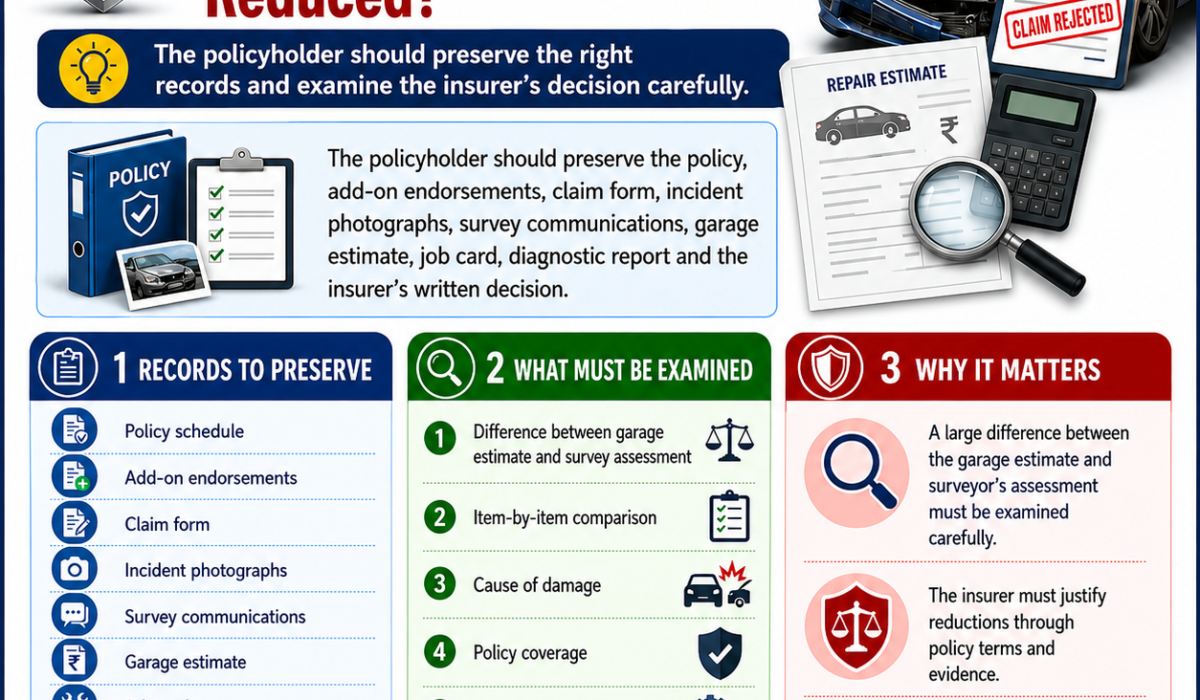
When a vehicle own-damage claim is rejected or substantially reduced, the policyholder should preserve the policy, claim form, accident or incident records, photographs, videos, survey communications, garage estimate, job card, diagnostic report, final repair bill and the insurer’s written decision.
The main questions are whether the reported event was covered, whether the damage was caused by that event, whether the surveyor inspected all relevant damage, whether the deductions follow the policy and whether the insurer has clearly explained any excluded parts or reduced assessment.
What Is Vehicle Own-Damage Insurance?
Third-party motor insurance covers legal liability arising from injury or damage caused to another person. It does not ordinarily pay for damage to the insured vehicle itself. Own-damage protection is available through a comprehensive or package policy, bundled policy or standalone own-damage policy, subject to the applicable terms and exclusions.
IRDAI explains that own-damage cover protects against loss or damage to the insured vehicle and that the applicable coverage, deductible, Insured Declared Value and add-on covers must be examined carefully. Common add-ons may include nil depreciation, return to invoice and no-claim-bonus protection, but the exact benefits vary according to the policy.
A policyholder should therefore first verify whether own-damage cover was in force on the date of loss. A liability-only policy will not ordinarily cover repair damage to the insured vehicle.
Common Reasons for Rejection or Reduced Settlement
An insurer may allege that the damage was not caused by the incident reported in the claim form. For example, after a collision, the insurer may accept damage to one portion of the vehicle but contend that engine, suspension, electrical or underbody damage was pre-existing or unrelated.
In flood or water-entry cases, the insurer may dispute whether the vehicle was damaged by inundation, whether the engine was restarted after water entered, whether hydrostatic lock occurred or whether consequential engine damage falls within the policy and add-on coverage. The exact cause of damage should be supported by photographs, towing records, workshop diagnosis, inspection findings and the sequence of events.
Another common dispute concerns delayed claim intimation. The insurer may allege that it was not informed promptly or that the vehicle was repaired before inspection. The policyholder should explain the circumstances, preserve call records and emails and show whether any delay actually prevented verification of the loss.
The insurer may also allege breach of policy conditions relating to the driving licence, permitted use, registration, fitness certificate, unauthorised use, intoxication, overloading or material misrepresentation. Each ground should be examined against the actual facts and the specific policy clause.
A claim may be partly settled because the insurer applies depreciation, compulsory deductible, voluntary deductible, salvage value, policy exclusions, betterment or a finding that some damaged parts were not affected by the insured event. Where a nil-depreciation add-on exists, the terms and limitations of that add-on should be examined before accepting depreciation deductions.
The Role of the Surveyor and Loss Assessor
A surveyor and loss assessor is licensed to investigate, inspect, quantify and report on insurance losses. IRDAI describes the surveyor’s role as including inspection, measurement, determination of the nature and extent of loss and advice concerning loss minimisation and related matters. Surveyors are expected to act with competence, objectivity and professional integrity.
The surveyor may conduct a spot inspection, inspect the vehicle at the garage, examine photographs, assess damaged parts, compare the repair estimate with policy coverage and recommend a loss amount to the insurer.
The surveyor’s report is important evidence, but it should not be treated as automatically conclusive in every dispute. The Insurance Act recognises the role of an approved surveyor while also stating that the insurer may settle a claim at an amount different from the surveyor’s assessment. A dispute may therefore require examination of both the surveyor’s reasoning and the insurer’s final decision.
If the policyholder believes that major damage was omitted, the surveyor should be asked in writing to conduct a reinspection before the relevant parts are repaired, removed or discarded.
What Should Be Checked in the Surveyor’s Assessment?
The policyholder should check whether the surveyor inspected the vehicle promptly and whether all alleged damage was visible and accessible during inspection. In some cases, internal damage becomes clear only after dismantling. The garage should notify the surveyor and insurer before dismantling or carrying out additional repairs.
The assessment should identify which parts were admitted, which were excluded, what depreciation was applied, what labour charges were allowed, what deductible was imposed and whether salvage was considered.
Where the surveyor concludes that a damaged component was unrelated to the accident, the report should ideally explain the technical basis for that conclusion. A bare statement that the damage is “old,” “unrelated” or “consequential” may require further clarification.
The policyholder should also compare the survey assessment with the garage job card, diagnostic report, photographs and estimate. A large difference between the garage estimate and survey assessment does not by itself prove wrongful settlement, because a garage estimate may include replacement of parts that can be repaired or items not covered by the policy. The difference must be examined item by item.
Garage Estimate and Repair Records
The initial garage estimate is only a preliminary assessment. It may change after dismantling, diagnostics or discovery of hidden damage. The policyholder should preserve every revised estimate and ask the garage to explain why additional work became necessary.
The job card should record the date of receipt of the vehicle, odometer reading, reported incident, visible damage, customer complaint and proposed inspection. In flood or water-entry cases, the garage should record whether the engine was running, stalled, restarted, towed or dismantled before inspection.
A technical diagnostic report can be valuable where the insurer disputes the cause of engine, transmission, electrical, electronic or suspension damage. The report should clearly connect the damage to the reported event where technically supportable.
After repair, the policyholder should obtain the final invoice, itemised labour charges, parts list, payment receipts and details of parts replaced. Damaged parts should not be discarded before the insurer or surveyor has completed inspection, unless their disposal is authorised or properly documented.
Documents the Policyholder Should Preserve
The policyholder should preserve the complete policy schedule, policy wording, own-damage section, add-on endorsements, premium receipt, registration certificate, driving licence and any fitness or permit records applicable to the vehicle.
The claim records should include the claim form, claim-intimation acknowledgment, claim number, surveyor appointment, emails, messages, inspection photographs, survey queries, garage estimate, job card, diagnostic report, towing bill, repair invoice and payment proof.
Where the incident involved an accident, flood, fire, theft attempt, falling object or other external event, the policyholder should preserve photographs, videos, police records where available, fire and rescue records where relevant, weather records, towing records, witness details and any contemporaneous communication.
Loan records may also be relevant where the vehicle remains under finance and the owner continues paying instalments during a prolonged claim or repair delay. However, every financial burden is not automatically recoverable from the insurer. The connection between the insurer’s conduct and the claimed loss must be established.
What Should the Vehicle Owner Do Immediately?
The incident should be reported to the insurer as soon as reasonably possible through a traceable channel. The vehicle should not be repaired before inspection unless emergency steps are necessary to prevent further damage or ensure safety.
Photographs and videos should be taken before towing and again at the garage. They should show the complete vehicle, damaged area, surrounding circumstances, water level or debris where relevant, registration number and any visible external impact.
The garage should be instructed not to dismantle major components without informing the insurer or surveyor. Where dismantling is necessary to identify hidden damage, written permission or reinspection should be requested.
The policyholder should prepare a short chronology stating when and where the incident occurred, how the vehicle was affected, whether it was driven or towed, when the insurer was informed, when the surveyor inspected it and when the garage submitted its estimate.
Flood and Water-Damage Claims
Flood-related claims often turn on the difference between direct external damage and consequential engine damage. The insurer may accept flood or inundation damage to the vehicle but dispute engine damage where the engine was allegedly cranked or restarted after water entry.
The policyholder should preserve photographs showing the location and water level, towing records, call logs, local authority or weather records where relevant and the garage’s technical diagnosis. The chronology should clearly state whether the engine stalled, whether any restart was attempted and what instructions were given by the insurer or towing provider.
The availability of engine-protection or similar add-on coverage should be checked. The exact policy wording will determine whether specified consequential engine or gearbox damage is covered.
When Parts Are Excluded as Unrelated Damage
Where the insurer excludes a major component as unrelated to the accident, the policyholder should request a written explanation identifying the technical basis and the evidence relied on.
The garage or an independent automobile engineer may be able to provide a reasoned opinion addressing whether the damage pattern is consistent with the reported impact, water entry, fire, overturning or other event.
A technical opinion should not merely repeat the policyholder’s allegation. It should identify the component, condition observed, probable mechanism of damage and supporting photographs or diagnostic findings.
Total Loss and Insured Declared Value
The Insured Declared Value is generally relevant to the maximum own-damage liability for total-loss or constructive-total-loss situations, subject to the policy. It is not automatically payable for every serious accident.
The insurer may compare the assessed repair cost with the applicable value and policy criteria before deciding whether the vehicle should be repaired or treated as a total loss.
Where the insurer proposes a total-loss settlement, the policyholder should examine the IDV, salvage treatment, loan endorsement, deductible and ownership-transfer requirements before accepting the offer.
When Should a Written Grievance Be Filed?
A written grievance should be considered where the insurer does not provide a reasoned decision, excludes major damage without explanation, delays survey or reinspection, applies unexplained deductions, ignores an add-on cover, rejects the claim on an incorrect factual basis or fails to address supporting technical evidence.
The grievance should identify the policy number, claim number, date and cause of loss, vehicle details, survey history, disputed parts, garage estimate, amount offered or rejected and the precise relief requested.
The policyholder should not merely state that the surveyor’s amount is low. The grievance should explain item by item why the excluded repair or deduction is disputed.
When May the Insurance Ombudsman Be Relevant?
After first approaching the insurer’s grievance mechanism, an eligible policyholder may consider the Insurance Ombudsman where the dispute falls within the applicable jurisdiction, limitation and monetary requirements.
The Ombudsman route may be relevant to repudiation, partial settlement, delay, policy interpretation and claim-handling disputes. The current rules and eligibility should be verified before filing.
When May a Consumer Commission Complaint Be Considered?
A Consumer Commission complaint may be considered where the policyholder alleges wrongful repudiation, arbitrary partial settlement, unreasonable delay, failure to apply an add-on cover, unsupported exclusion of damage or another deficiency in insurance service.
The complaint should ordinarily be supported by the policy, claim form, incident evidence, survey records, garage estimate, technical reports, repair bills, grievance communications and calculation of the relief sought.
A difference between the surveyor’s assessment and the garage estimate alone may not be sufficient. The policyholder should establish why the insurer’s decision is contractually, factually or technically unsustainable.
Readers may refer to the Vehicle Own-Damage Insurance Claim Dispute Lawyer in Ernakulam, Insurance Claim Dispute Lawyer in Ernakulam District and Consumer Case Lawyer in Ernakulam District service pages for related information.
Important Mistakes to Avoid
The vehicle should not be repaired immediately without giving the insurer a reasonable opportunity to inspect, unless urgent action is necessary and properly documented.
The policyholder should avoid exaggerating the accident circumstances, hiding earlier damage, submitting inconsistent versions or allowing damaged parts to be discarded before inspection.
Another common mistake is accepting a verbal explanation from the surveyor or garage without obtaining the insurer’s final written decision. The repudiation, deduction or partial settlement should be obtained in writing with the policy clause and calculation.
The policyholder should also avoid delaying grievance or legal action while storage charges, loan instalments and repair expenses continue to accumulate. Limitation and procedural requirements should be reviewed promptly.
Practical Relevance Within Ernakulam District
Vehicle own-damage disputes in Ernakulam may arise from road accidents, flooding, waterlogging, falling trees or objects, fire, vandalism, theft attempts, underbody impact and disputed engine or electrical damage.
The most important evidence is usually the policy wording, add-on cover, incident photographs, towing records, surveyor assessment, garage diagnosis, itemised repair estimate and the insurer’s written decision.
RPR Legal Nexus mainly handles suitable vehicle own-damage and consumer insurance disputes within Ernakulam District after examining the policy, incident chronology, survey records and technical evidence.
Frequently Asked Questions
Is the insurer required to accept the full garage estimate?
No. A garage estimate is evidence of proposed repair cost, but the insurer may examine whether the parts and repairs are connected to the insured event and admissible under the policy. Any major difference should be explained item by item.
Is the surveyor’s report final and binding?
The surveyor’s report is important evidence, but the insurer makes the claim decision. In a dispute, the report, insurer’s reasoning and contrary technical evidence may all be examined.
Can a policyholder request reinspection?
Yes. Reinspection should be requested promptly where hidden damage becomes visible after dismantling or where an important component was not properly examined.
Can flood damage to the engine be rejected?
The answer depends on the cause of damage, policy exclusions and availability of add-on coverage. Evidence concerning water entry, restarting, towing and technical diagnosis is important.
Does a nil-depreciation add-on remove every deduction?
Not necessarily. The add-on must be read carefully. Deductibles, exclusions, claim limits and items outside coverage may still apply.
Can storage charges and loss of use be claimed?
Such losses may be claimed where legally sustainable and supported by evidence, but recovery is not automatic. The policy terms, cause of delay and actual proof must be examined.
Can a claim be filed without a police report?
A police report may not be compulsory for every own-damage incident. Its necessity depends on the nature of the incident, policy requirements and surrounding circumstances.
What should be done when the insurer does not provide the survey report?
The policyholder should request the survey findings, assessment basis and the insurer’s reasoned claim decision in writing. The available grievance mechanism may then be used.
Related Consumer Law Services
Readers dealing with rejected, delayed or partly approved vehicle damage claims may find the Vehicle Own-Damage Insurance Claim Dispute Lawyer in Ernakulam, Insurance Claim Dispute Lawyer in Ernakulam District and Consumer Case Lawyer in Ernakulam District service pages useful.
Seeking Guidance on a Vehicle Own-Damage Claim Dispute?
A policyholder facing rejection or substantial reduction should first organise the policy schedule, add-on endorsements, claim form, photographs, survey communications, garage estimate, job card, diagnostic report, repair bill and insurer’s written decision.
A document-based review can help identify whether the insurer’s decision is supported by the policy and technical evidence, whether reinspection or an independent assessment is required and which further remedy may be appropriate.
RPR Legal Nexus
Adv. Raghesh Issac P
Consumer Law Advocate
Ernakulam, Kerala
Call / WhatsApp: 9400222945
Email: rprkeralaservices@gmail.com
Office:
60/3877A-3, Luiz Lane, near Thevara Market
Perumanoor, Kochi, Ernakulam, Kerala 682015
Follow RPR Legal Nexus
Google Maps / Google Business Profile
WhatsApp Channel
Facebook
Instagram
LinkedIn Company Page
LinkedIn Profile of Adv. Raghesh Issac P
YouTube Channel
⚠ Disclaimer
This article is provided solely for general legal awareness and should not be treated as legal advice. Health insurance disputes depend on the proposal form, policy wording, network status, waiting periods, medical necessity, previous medical history, cashless decision, reimbursement claim, jurisdiction, limitation, evidence and applicable regulatory framework.
No lawyer-client relationship is created merely by reading this article, visiting the website, submitting an enquiry or sharing preliminary information. Legal advice or representation can be provided only after proper review of the facts and documents and professional engagement.
RPR Legal Nexus mainly handles suitable consumer law matters within Ernakulam District. MACT cases, road accident injury compensation claims, criminal cases, family cases and property partition disputes are not the main service areas of this practice.
Written by: Adv. Raghesh Issac P
Consumer Law Advocate, RPR Legal Nexus
Published:
Last reviewed: