







Defective House Construction: Cracks, Leakage and Poor Workmanship—What Evidence Is Important?
Defective house construction can cause serious loss to a homeowner. Cracks may appear in walls, leakage may continue during rain, tiles may loosen, plaster may peel, electrical work may remain unsafe, plumbing may fail, or finishing work may be visibly poor. The contractor may say these are minor issues, natural settlement, ordinary wear and tear, or maintenance problems.
But when construction defects affect the quality, safety, usability or value of the building, the consumer should preserve evidence before carrying out repairs. Once another contractor repairs the defects, it may become difficult to prove the original condition.
This article explains what evidence is important when a homeowner faces cracks, leakage or poor workmanship after construction, renovation or finishing work.
In Brief
In a defective house construction dispute, the homeowner should preserve the agreement, quotation, drawings, material specifications, payment proof, photographs, videos, defect list, site communications, repair estimates and expert engineer assessment where required. Cracks, leakage and poor workmanship should be documented before rectification. The main questions are what quality of work was promised, what defect appeared, when it appeared, whether the contractor was informed, whether rectification was attempted and what cost is required to correct the defect. A written demand, legal notice or Consumer Commission complaint may become relevant depending on the facts and evidence.
What Is the Issue?
The issue is not merely that the homeowner is dissatisfied with the appearance of the work. The real question is whether the construction service suffered from defects, poor workmanship, inferior materials, incomplete execution or failure to follow agreed specifications.
Defective construction may arise in full house construction, home renovation, waterproofing, roofing, truss work, plastering, tiling, flooring, plumbing, electrical work, painting, aluminium fabrication, interior work or compound-wall construction.
Where the dispute concerns broader construction delay, abandonment or quality issues, readers may refer to the page on construction disputes for related service information.
Defect evidence is different from delay evidence. Delay focuses on time and non-completion. Defect evidence focuses on quality, technical failure, materials used, workmanship and rectification cost.
Common Reasons Given by the Contractor or Builder
A contractor may say that cracks are normal settlement cracks. Some minor cracks may occur naturally, but the size, location, timing and pattern of cracks should be assessed carefully.
The contractor may say leakage is due to heavy rain or lack of maintenance. The homeowner should check whether waterproofing, roof slope, drainage, plumbing joints, terrace finishing or external plastering was defective.
The contractor may say that poor finishing is only a cosmetic issue. But poor workmanship may affect durability, safety, water resistance, electrical safety or usability.
The contractor may allege that the consumer selected low-cost materials. In such cases, quotations, material specifications, bills, brand details, WhatsApp approvals and site photographs become important.
The contractor may also say that defects appeared after another worker interfered with the site. This is why the homeowner should document defects before allowing rectification by a new contractor.
Where a service provider later raises technical objections or denies responsibility in a consumer case, the page on opposite party defence in consumer cases may be useful for understanding possible defence patterns.
Important Documents or Evidence
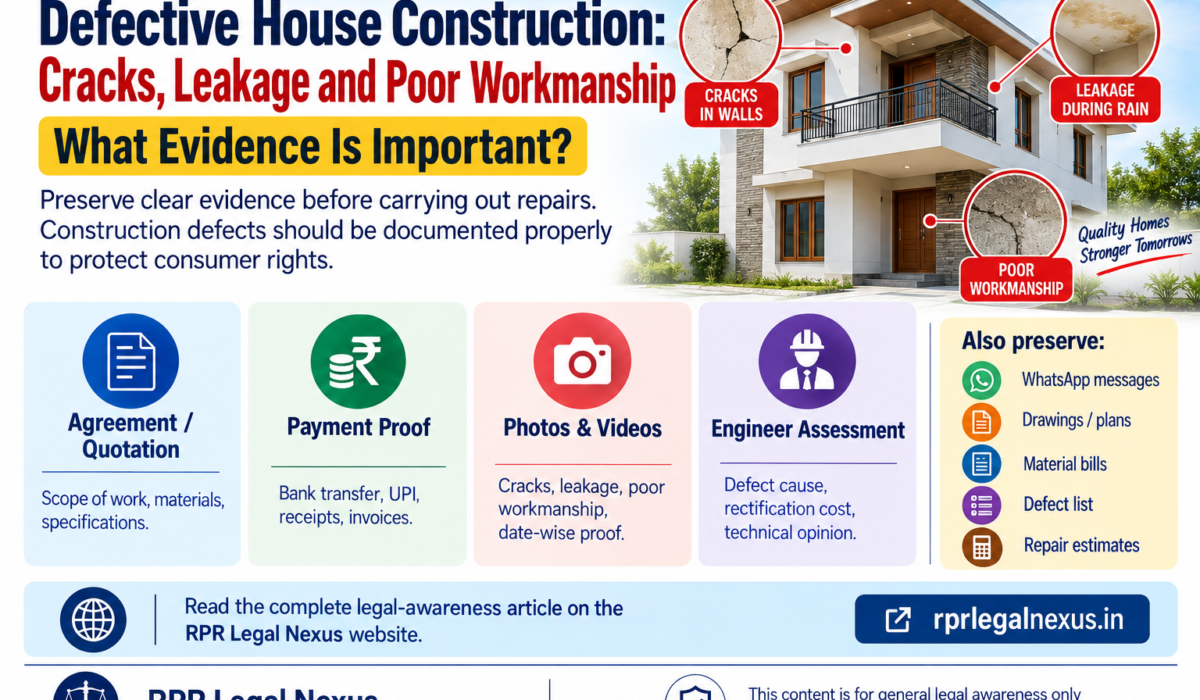
The first important document is the agreement or quotation. It may show the promised scope of work, quality, materials, measurements, price and completion schedule.
The second important evidence is payment proof. Bank transfers, UPI records, cheque details, receipts, cash acknowledgments and invoices help prove that construction service was hired for consideration.
The third important evidence is photographs and videos. These should show the defect clearly and should be preserved in date order.
The fourth important evidence is written communication. WhatsApp messages, emails, letters, voice-note references, complaint messages and contractor replies may show when the defect was reported and what the contractor promised.
The fifth important evidence is technical assessment. In serious defect cases, an engineer’s report may help explain the nature of defects, probable cause, rectification method and estimated cost.
If advance payment and incomplete work are also involved, the article on evidence to preserve when a contractor takes advance may also be useful.
Evidence of Cracks
Cracks should be photographed carefully. A single close-up photo may not be enough. The homeowner should take:
a wide photograph showing the room or wall;
a medium photograph showing the location of the crack;
a close-up photograph showing the crack clearly;
a photograph with scale, such as a measuring tape or ruler;
date-wise photographs showing whether the crack increased.
The homeowner should note when the crack first appeared. If the crack appeared soon after plastering, painting, slab work or structural work, the timeline may become important.
Cracks near beams, columns, slabs, joints, lintels, staircases, compound walls or retaining walls may require technical examination. The homeowner should not assume that every crack is structural, but serious cracks should not be ignored.
Evidence of Leakage and Water Seepage
Leakage should be documented during rain or when water seepage is visible. Videos can be more useful than still photographs because they show active leakage.
The homeowner should record the affected area, date, time, weather condition and source of leakage if visible. For example, terrace leakage, bathroom leakage, plumbing leakage, wall seepage, roof leakage or window-frame leakage should be separately identified.
If leakage damages paint, woodwork, electrical fittings, furniture or flooring, those damages should also be photographed.
The homeowner should preserve waterproofing bills, plumbing bills, material details, roof-slope photographs, drain photographs and contractor messages about rectification.
Repeated leakage after repair is especially important. Each repair attempt and failure should be documented.
Evidence of Poor Workmanship
Poor workmanship may include uneven flooring, improper tile alignment, hollow tiles, poor plastering, defective painting, weak finishing, improper slope, faulty electrical work, plumbing defects, rusting, poor welding, defective doors or windows, and use of inferior materials.
Photographs should be clear and specific. The homeowner should avoid only taking general photos of the house. Each defect should be separately documented.
For example, in tile defects, photographs and videos may show hollow sound, uneven levels, cracks, loose tiles or water stagnation.
In electrical defects, photographs may show exposed wiring, unsafe joints, improper switchboard fitting or repeated failure. However, electrical defects should be inspected safely by a qualified person.
In plumbing defects, photographs and videos may show leakage, low pressure, blocked lines, improper slope or wet walls.
Evidence of Inferior Materials
If the complaint is about inferior materials, the homeowner should preserve the agreed specification and actual material proof.
Important evidence may include the quotation, brand names promised, material bills, delivery challans, photographs of material bags or labels, WhatsApp approvals, site photographs and leftover samples where available.
If the contractor promised a particular brand of cement, steel, tile, paint, pipe, wire, waterproofing product or hardware item, that promise should be proved through written records.
Inferior material allegations should be made carefully. A technical assessment may be required to show whether the material used was different from what was agreed or unsuitable for the work.
Role of an Expert Engineer Report
An expert engineer report can be very useful in defective construction disputes. It can help convert visible complaints into technical findings.
An engineer may identify:
nature of the defect;
probable cause;
whether workmanship appears defective;
whether materials appear substandard;
whether work deviates from agreed specification;
whether the defect affects safety or usability;
estimated cost of rectification;
whether further investigation is required.
The report should be practical and clear. It should avoid exaggerated findings unless supported by inspection, measurements, photographs and technical reasoning.
In some cases, a party may seek appointment of an expert commissioner or technical inspection through the appropriate forum. Whether that is necessary depends on the case stage, nature of defect and available evidence.
What the Consumer Should Check
The consumer should first check the agreement, quotation and specification. Without knowing what was promised, it may be difficult to prove what was defective.
The second check is timing. Did the defect appear during work, immediately after completion, during defect-liability period, after first rain or much later?
The third check is notice to the contractor. The consumer should preserve messages showing that the defect was reported.
The fourth check is rectification attempts. If the contractor came and repaired the defect, those dates and results should be recorded.
The fifth check is repair cost. The consumer should obtain estimates from another qualified person before claiming rectification cost.
The sixth check is whether the work is incomplete, defective or both. Incomplete work and defective work should be separately listed.
What the Consumer Should Do First
The first practical step is to prepare a defect list room-wise or area-wise. For example: terrace leakage, bedroom wall crack, bathroom seepage, kitchen tile defect, electrical issue, plumbing issue and exterior plaster defect.
The second step is to take clear photographs and videos before repair.
The third step is to send a written complaint to the contractor. The complaint should mention defects, date noticed, photographs attached and rectification requested.
The fourth step is to avoid immediate repair without evidence unless there is urgent safety risk. If urgent repair is necessary, the homeowner should document the condition before repair and preserve repair bills.
The fifth step is to obtain an engineer’s assessment where the defect is serious, technical or expensive to rectify.
The sixth step is to preserve all further expenditure, including repair bills, material purchases, labour payments and temporary arrangements.
When Legal Notice or Consumer Commission Proceeding May Be Relevant
A legal notice may be considered where the contractor ignores defect complaints, refuses rectification, gives only oral promises, denies responsibility, demands more money or leaves the homeowner to bear rectification expenses.
A Consumer Commission complaint may be considered where the homeowner alleges deficiency in service, defective workmanship, poor materials, failure to rectify defects, incomplete construction, unfair demand or non-refund.
Official consumer-law material explains that “deficiency” includes fault, imperfection, shortcoming or inadequacy in the quality, nature and manner of performance of a service. This may become relevant in defective construction service disputes, depending on the agreement, evidence and facts.
For broader consumer-service remedies, readers may refer to consumer law services.
Legal Issues
Defective house construction disputes usually involve proof of contract, proof of payment, agreed specifications, defective workmanship, use of inferior materials, failure to rectify, loss caused and deficiency in service.
The consumer must prove that construction or renovation service was hired for consideration. This may be shown through agreement, quotation, payment records, receipts, invoices or messages.
The consumer must also prove that the work was defective. Photographs may show visible defects, but technical defects may require engineer assessment.
The contractor may be responsible for rectifying defects if the defect arises from poor workmanship, non-compliance with agreed specifications or defective execution. But each case must be assessed on its own facts.
Important Mistakes to Avoid
Consumers should not repair all defects immediately without preserving evidence. Once the defect is repaired, the contractor may deny the original condition.
They should not rely only on oral complaints. Defects should be reported in writing with photographs.
Consumers should not mix all defects into one vague allegation. Each defect should be separately listed.
They should not exaggerate technical allegations without expert support. Serious allegations such as structural weakness should be supported by proper inspection.
Consumers should not make further payments only because the contractor promises rectification. Payment and rectification terms should be recorded.
They should not ignore limitation, jurisdiction and proper party details. Contractor name, business name, address, phone number, GST invoice if any and bank-recipient details should be preserved.
Practical Relevance for Consumers
Defective construction disputes may affect house owners, apartment owners, renovation customers, interior-work customers, shop owners and NRIs managing construction from outside India.
Common issues include cracks, leakage, poor waterproofing, defective plastering, uneven flooring, plumbing defects, unsafe electrical work, inferior materials, poor finishing, abandoned rectification and repeated repair failure.
Consumers considering any further step should first organise the agreement, quotation, specifications, payment proof, photographs, videos, defect list, contractor communications, repair estimates and engineer report.
The correct legal remedy may differ depending on the place of construction, residence of parties, nature of defect, agreement terms, payment records, jurisdiction, limitation period, expert opinion and relief sought.
Where the owner is living abroad or managing construction remotely, the page on NRI consumer legal assistance may also be relevant.
Frequently Asked Questions
Is every crack in a new house a construction defect?
Not necessarily. Some minor cracks may occur due to settlement or temperature changes. However, serious, repeated, expanding or structural-location cracks should be documented and assessed technically.
What is the best evidence for leakage?
Videos taken during active leakage, photographs of affected areas, rain-date details, waterproofing records, plumbing records, contractor messages and engineer assessment may be useful.
Should defects be repaired before sending notice?
If urgent repair is required for safety, it may have to be done. But before repair, the homeowner should preserve photographs, videos and repair estimates. Otherwise, proving the original defect may become difficult.
Is an engineer report necessary?
Not in every minor dispute. But where defects are serious, technical, costly or disputed, an engineer’s report may help prove the nature, cause and rectification cost.
What if the contractor says the defect is due to poor maintenance?
The consumer should preserve the timeline, photographs, usage history, repair requests and expert assessment. Early appearance of defects may help rebut a general maintenance defence.
Can defective workmanship be a consumer dispute?
It may be considered where construction or renovation service was hired for consideration and the work allegedly suffers from deficiency in service. The outcome depends on documents and evidence.
What relief can a homeowner claim?
Depending on the facts, the homeowner may seek rectification, refund, cost of repair, compensation for loss, litigation cost and other appropriate relief. The claim should be supported by documents.
Related Consumer Law Services
Readers dealing with cracks, leakage, poor workmanship, inferior materials, incomplete construction or contractor refusal to rectify may refer to the pages on construction disputes, builder and contractor delay disputes, consumer law servicesand NRI consumer legal assistance for related information.
Practical Document Checklist Before Taking Any Step
In a defective house construction dispute, the first practical step is to organise the agreement, quotation, drawings, specifications, payment proof, receipts, invoices, site photographs, videos, defect list, contractor messages, repair estimates, engineer report and rectification bills if any.
After the records are organised, the issue should be examined carefully to understand whether the grievance relates to cracks, leakage, poor workmanship, inferior materials, incomplete work, repeated repair failure, contractor refusal, structural concern or another consumer law issue. A clear document-based understanding helps avoid vague allegations and supports a more responsible decision on the next legal or procedural step.
RPR Legal Nexus
Adv. Raghesh Issac P
Consumer Law Advocate
Ernakulam, Kerala
Call / WhatsApp: 9400222945
Email: rprkeralaservices@gmail.com
Office:
60/3877A-3, Luiz Lane, near Thevara Market
Perumanoor, Kochi, Ernakulam, Kerala 682015
Follow RPR Legal Nexus
Google Maps / Google Business Profile
WhatsApp Channel
Facebook
Instagram
LinkedIn Company Page
LinkedIn Profile of Adv. Raghesh Issac P
YouTube Channel
Disclaimer
This article is provided solely for general legal awareness and should not be treated as legal advice. Defective construction disputes depend on the agreement, quotation, specifications, payment records, site condition, photographs, engineer report, correspondence, jurisdiction, limitation and the facts of each matter.No lawyer-client relationship is created merely by reading this article, visiting the website, submitting an enquiry or sharing preliminary information. Legal advice or representation can be provided only after proper review of the facts and documents and professional engagement.RPR Legal Nexus mainly handles suitable consumer law matters. MACT cases, road accident injury compensation claims, criminal cases, family cases and property partition disputes are not the main service areas of this practice.
Written/Reviewed by: Adv. Raghesh Issac P
Consumer Law Advocate
RPR Legal Nexus
Ernakulam, Kerala
Published: 14/09/2026
Last reviewed: 14/09/2026