







Health Insurance Claim Rejected for Non-Disclosure: What Should the Policyholder Check First?
A health insurance claim may be rejected when the insurer alleges that the policyholder failed to disclose an earlier illness, treatment, consultation, investigation, surgery, medication or other material medical information while purchasing the policy.
A rejection for “non-disclosure” can have wider consequences than the rejection of one hospital bill. In some cases, the insurer may question not only the particular claim but also the continuation of the policy itself. For that reason, a policyholder should not accept such an allegation without carefully examining the proposal form, medical history, policy documents and the evidence relied upon by the insurer.
The central questions are usually straightforward: What information did the insurer actually ask for? What did the policyholder genuinely know at that time? What answer was entered in the proposal form? What medical record is now being relied upon by the insurer?
This article explains what a policyholder should check first when a health insurance claim is rejected for alleged non-disclosure.
In Brief
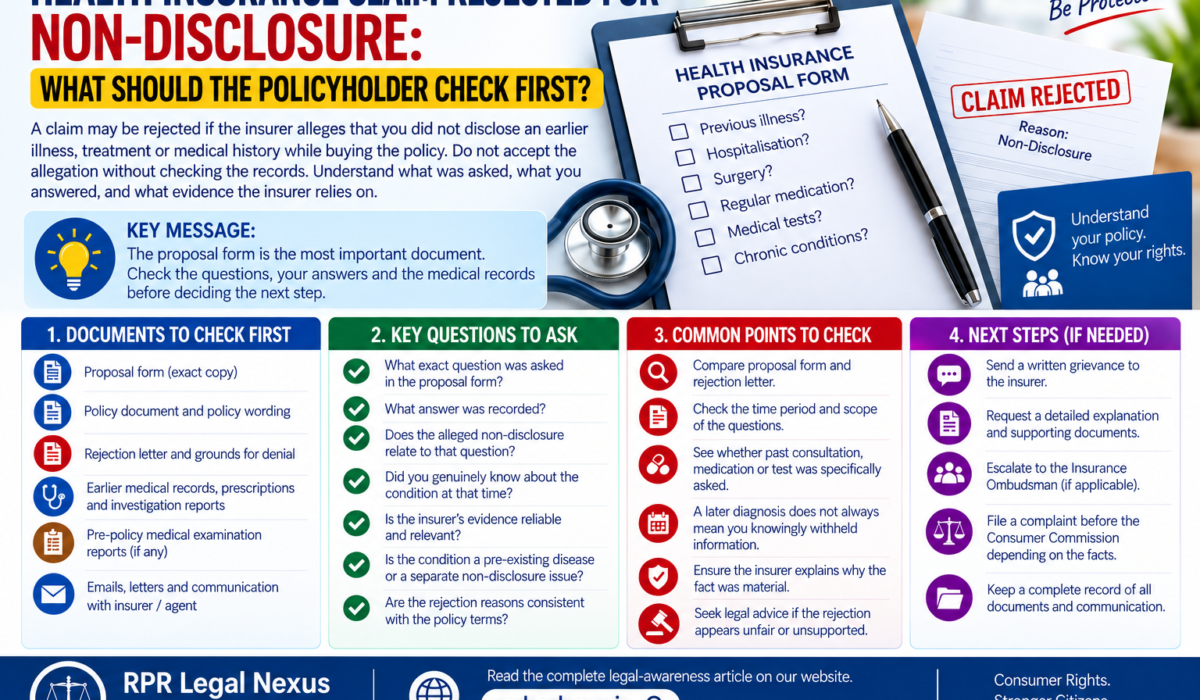
When a health insurance claim is rejected for non-disclosure, the proposal form should be one of the first documents examined. It should be compared with the rejection letter, earlier medical records, hospital history, prescriptions, pre-policy medical examination records and policy documents.
A later diagnosis does not automatically prove that the policyholder knowingly withheld information when the policy was purchased. The insurer should be able to identify the allegedly undisclosed fact, explain why it was material and support the allegation with reliable medical evidence.
Depending on the records and circumstances, a written grievance, Insurance Ombudsman complaint or Consumer Commission proceeding may become relevant.
What Does “Non-Disclosure” Mean in Health Insurance?
When a person applies for health insurance, the insurer normally asks questions regarding previous illnesses, hospitalisations, medication, investigations, surgeries and other matters that may affect underwriting.
A non-disclosure dispute arises when the insurer later claims that information which should have been revealed at the proposal stage was omitted, inaccurately answered or concealed.
However, the allegation should not be considered in isolation. The exact wording of the proposal question, the proposer’s knowledge at the relevant time, the medical history available then and the evidence relied upon by the insurer all become important.
A policyholder who has received a general repudiation may first refer to the broader guide on what to check before accepting a health insurance claim rejection.
Non-Disclosure and Pre-Existing Disease Are Not the Same Issue
Pre-existing disease and non-disclosure frequently overlap, but they are not automatically the same.
A pre-existing disease dispute generally concerns whether a medical condition existed, was diagnosed or was treated before the relevant policy period in a manner covered by the policy definition.
A non-disclosure dispute focuses on whether the proposer knew a material medical fact and failed to disclose it when specifically required during the proposal process.
For example, an insurer may allege that the insured failed to mention a surgery performed several years earlier even though the present claim relates to another illness. In that situation, the issue is not merely whether the earlier surgery existed. It is also necessary to examine whether the proposal form asked about earlier surgery and what answer was recorded.
Where the insurer specifically alleges that the present illness itself was pre-existing, the article on documents that may help challenge a pre-existing disease rejection may also be relevant.
Obtain the Proposal Form First
The proposal form is often the most important document in a non-disclosure dispute.
The policyholder should obtain the exact proposal form submitted at the time the policy was purchased. It should be checked carefully to see what questions were asked regarding previous disease, hospitalisation, surgery, regular medication, investigations, diagnostic tests, chronic conditions and other health-related matters.
The answers entered in the form should then be compared with the alleged non-disclosure mentioned in the rejection letter.
The policyholder should not rely only on what an insurance agent, intermediary or sales representative remembers. The actual proposal form and recorded declarations are far more important.
Check What Question Was Actually Asked
An insurer may allege that a medical fact was not disclosed, but the first question should always be whether the proposal form actually required disclosure of that fact.
For example, if the insurer says that an old consultation was not disclosed, the consumer should identify whether the form asked about all previous consultations, only hospitalisations, chronic illnesses, surgeries, regular medicines or treatment within a particular period.
Similarly, if the insurer alleges non-disclosure of medication, the proposal form should be checked to see whether it asked about current medication, long-term medication or any past medication.
A useful method is to compare the exact question asked, the answer recorded, the medical fact later relied upon and the insurer’s conclusion. This often reveals whether the rejection is properly connected to the proposal process.
What Did the Policyholder Actually Know?
Knowledge is often one of the most important factual issues.
A person may experience symptoms without knowing the underlying disease. A blood test may later be interpreted as abnormal. A disease may be formally diagnosed only after the insurance policy begins.
For example, occasional abdominal pain does not automatically prove knowledge of liver disease. An isolated abnormal laboratory result does not necessarily prove that the patient knew of a specific diagnosis unless the medical history supports that conclusion.
The policyholder should therefore check whether the disease had actually been diagnosed earlier, whether any doctor had informed the patient of the condition, whether treatment was prescribed, whether regular medication was taken and whether any earlier record clearly mentions the diagnosis.
The answer should come from contemporaneous medical records rather than assumptions made after the claim.
Examine the Medical Record Relied Upon by the Insurer
The rejection letter should be examined carefully to identify the medical document relied upon.
Insurers may rely on old prescriptions, earlier discharge summaries, investigation reports, hospital admission history, statements such as “known case of,” medication history, previous insurance claims or health-check records.
The policyholder should obtain the exact document and read it in context.
For example, a hospital record stating “history of illness for five years” may require clarification. It may refer to symptoms rather than a confirmed diagnosis. It may also have been recorded inaccurately or based on a general history provided during admission.
If important hospital records are missing, the guide on what patients can do when hospitals delay or refuse medical records may be useful.
What If the Proposal Form Was Filled by an Agent?
Many health insurance policies are purchased with assistance from agents, bank staff, intermediaries or sales representatives.
A policyholder may later say that all medical information was disclosed orally but the intermediary completed the proposal form incorrectly. That issue can become important, but it should be supported by evidence wherever possible.
WhatsApp chats, emails, medical records sent to the agent, proposal links, recorded sales calls and messages discussing health history should be preserved.
The policyholder should also check whether a copy of the completed proposal form was provided before or after policy issuance.
A general allegation that “the agent filled everything” may not be enough. It is more useful to identify what information was given to the intermediary and whether there is any record of that communication.
What If the Policy Was Purchased Online?
Online policies create their own evidence trail.
The consumer should preserve the proposal PDF, application confirmation, OTP communication, online declarations, medical documents uploaded, insurer emails, payment confirmation and any underwriting queries.
The relevant health questions should be reviewed carefully. The fact that the policy was purchased digitally does not by itself remove the duty to answer questions accurately.
At the same time, the insurer should be able to show what questions were actually displayed to the proposer and what responses were recorded.
Did the Insurer Conduct a Pre-Policy Medical Examination?
A pre-policy medical examination may become important in a later non-disclosure dispute.
The policyholder should preserve medical-test requests, blood reports, ECG reports, medical questionnaires, underwriting communications and the insurer’s decision after the examination.
A medical examination does not automatically eliminate the proposer’s duty to disclose known information. However, it may become relevant if the insurer had access to medical information before accepting the proposal and issuing the policy.
The question then becomes whether the alleged medical fact was already available to the insurer during underwriting and how the insurer treated that information.
Was the Allegedly Undisclosed Fact Material?
Not every omitted detail necessarily has the same significance.
The insurer should identify the precise medical fact allegedly withheld and explain why that information was material to underwriting or the claim decision.
A policyholder should ask what exactly was not disclosed, when the policyholder allegedly knew about it, where the proposal form required disclosure, what medical record proves prior knowledge and how that information would have affected underwriting.
A grievance becomes more effective when these questions are addressed individually rather than merely stating that the rejection is unfair.
Check the Age and Continuity of the Policy
The number of continuous years of coverage may also become relevant.
The policyholder should preserve all earlier policy schedules, renewal records and portability documents rather than examining only the latest policy period.
Where the policy has continued for several years, the applicable regulatory framework, policy wording and moratorium-related provisions may require examination. The relevance of such provisions depends on the period of continuous coverage, applicable rules, fraud allegations and other policy conditions.
If the policy was ported from another insurer, continuity records may also become important.
Compare the Rejection Letter With the Claim Records
The rejection letter should clearly identify the alleged non-disclosure and explain why it affects the claim.
A practical way to analyse the dispute is to compare the allegation with the relevant supporting document. If the insurer alleges an undisclosed illness, compare it with earlier medical records. If the insurer alleges that the proposal form was answered incorrectly, examine the actual proposal form. If prior medication is alleged, obtain the prescriptions. If the insurer says the condition existed before policy commencement, verify the first diagnosis date.
This document-by-document comparison usually makes the real dispute much clearer.
What If the Hospital Record Contains an Incorrect Medical History?
Hospital records sometimes contain inaccurate or overly broad medical-history entries.
For example, a discharge summary may state that the patient was a “known diabetic for five years” or had “hypertension for ten years.” If the patient says the statement is incorrect, the entry should not simply be ignored.
Earlier prescriptions, laboratory reports, consultation records and treating-doctor clarification should be checked. Where appropriate, the patient may seek clarification or correction from the hospital.
The article on medical negligence evidence and hospital records explains why contemporaneous records should be preserved carefully before taking further steps.
What the Policyholder Should Do First
The first practical step is to collect the complete rejection file. This should include the rejection letter, proposal form, policy schedule, full policy wording, earlier medical records, present hospital records, previous prescriptions, pre-policy medical reports, agent communications, underwriting correspondence and renewal schedules.
The second step is to prepare a clear medical timeline. It should show the date of policy commencement, earlier consultations, first diagnosis, first treatment, hospitalisation, claim submission, insurer queries, replies and rejection.
The third step is to identify the exact alleged non-disclosure. Avoid responding generally. Determine precisely what medical fact the insurer says was withheld.
The fourth step is to prepare a written, document-based grievance answering the insurer’s allegation point by point.
When Grievance, Ombudsman or Consumer Commission Proceedings May Be Relevant
The insurer’s internal grievance mechanism is usually an important first step where the policyholder disputes a non-disclosure rejection.
The grievance should clearly identify the claim number, rejection reason, disputed medical allegation, proposal-form question, relevant medical records and relief requested.
If the insurer does not resolve the matter satisfactorily, an Insurance Ombudsman complaint may be considered in eligible cases subject to the applicable requirements.
A Consumer Commission complaint may also be considered where the policyholder alleges wrongful repudiation, arbitrary reliance on non-disclosure, failure to consider relevant records, unreasonable claim handling or other deficiency in service.
For broader insurance-related disputes, readers may refer to the page on insurance claim disputes.
Legal Issues
Health insurance non-disclosure disputes commonly involve the accuracy of the proposal form, materiality of the alleged fact, policyholder’s knowledge, previous medical records, underwriting process, policy wording, continuity of coverage and the insurer’s evidence.
A policyholder should not assume that every non-disclosure rejection is automatically wrong. If a material disease was clearly known, specifically asked about and deliberately withheld, the insurer may have a significant contractual defence.
At the same time, an insurer should not automatically treat a later diagnosis, vague symptom, isolated abnormal test or unclear hospital-history entry as proof of deliberate concealment.
The correct approach is to examine the entire chronology and the documentary record.
Important Mistakes to Avoid
A policyholder should not respond to a non-disclosure rejection without first obtaining the proposal form.
It is also important not to assume that pre-existing disease and non-disclosure are identical concepts. The two issues may overlap but require separate examination.
The policyholder should not rely only on the statement that an agent completed the form without preserving evidence of what was communicated to the agent.
Old medical records should not be ignored merely because the present claim concerns another disease. They may either support or contradict the insurer’s allegation.
A vague doctor certificate stating only that the illness was “not pre-existing” may not be sufficient. A useful medical clarification should address diagnosis, earlier treatment, prior knowledge and relevant dates.
The policyholder should also avoid altering, hiding or selectively presenting inconvenient records. Consistency across the proposal form, hospital records, claim form and grievance is important.
What If the Claim Was Only Partly Paid?
Sometimes an insurer does not reject the entire claim but reduces the payable amount after relying on prior medical history, policy restrictions or other deductions.
In such situations, the policyholder should request an item-wise settlement calculation and identify exactly how the alleged non-disclosure affected payment.
Where the dispute concerns a reduced settlement rather than total repudiation, the guide on disputing partial insurance claim deductions may also be useful.
Practical Relevance for Consumers
Non-disclosure allegations may arise in claims involving diabetes, hypertension, cardiac conditions, thyroid disease, liver disease, kidney disease, cancer, previous surgery, neurological illness and many other conditions.
They can also arise when the insured person did not consider an earlier consultation or test significant but the insurer later treats it as material.
Consumers considering any further step should first organise the proposal form, policy documents, earlier medical records, current hospital records, pre-policy medical examination reports, insurer queries, rejection letter and grievance communications.
The correct legal remedy may differ depending on policy wording, policy age, continuity, medical history, proposal questions, documentary evidence, jurisdiction, limitation period and relief sought.
Frequently Asked Questions
Is non-disclosure the same as pre-existing disease?
No. A pre-existing disease dispute concerns whether a medical condition falls within the policy definition. Non-disclosure concerns whether material information known to the proposer was required to be disclosed but was omitted or inaccurately stated.
Can a claim be rejected merely because the disease was diagnosed soon after policy commencement?
Not automatically. Early diagnosis may lead to closer scrutiny, but the insurer should still establish the relevant medical history, proposal-form disclosure requirements and supporting evidence.
What if the insurance agent completed the proposal form?
The policyholder should preserve evidence showing what information was provided to the agent. Messages, emails, documents and recorded communications may become important.
Why is the proposal form important?
The proposal form shows what medical questions were asked and what answers were recorded. It is often central to determining whether a genuine non-disclosure occurred.
What if the hospital recorded the previous medical history incorrectly?
The entry should be compared with earlier records. Where necessary, clarification may be sought from the hospital or treating doctor.
Does a pre-policy medical examination help?
It may become relevant because it shows what medical information was available to the insurer before policy issuance. Its significance depends on the particular facts.
Can a non-disclosure rejection be challenged before the Consumer Commission?
A complaint may be considered where wrongful repudiation or deficiency in service is alleged. The proposal form, medical records, policy wording, insurer reasoning and grievance history would ordinarily be important evidence.
Related Consumer Law Services
Readers dealing with alleged non-disclosure, pre-existing disease rejection, waiting-period disputes, cashless denial or partial settlement may refer to the pages on health insurance claim rejection disputes, insurance claim disputes and consumer law services for related information.
Practical Document Checklist Before Taking Any Step
In a health insurance rejection based on alleged non-disclosure, the policyholder should organise the proposal form, policy schedule, complete policy wording, all renewal schedules, portability records where relevant, pre-policy medical examination records, previous prescriptions, hospital records, investigation reports, present treatment records, discharge summary, claim form, insurer queries, replies, rejection letter, intermediary communications and grievance correspondence.
Once the documents are arranged, the central questions should be answered clearly: What fact does the insurer say was not disclosed? What proposal-form question required disclosure of that fact? Did the policyholder actually know the fact at the relevant time? What medical evidence supports or contradicts the insurer’s allegation?
A document-based analysis is far more useful than treating every non-disclosure rejection as automatically valid or automatically wrongful.
RPR Legal Nexus
Adv. Raghesh Issac P
Consumer Law Advocate
Ernakulam, Kerala
Call / WhatsApp: 9400222945
Email: rprkeralaservices@gmail.com
Office:
60/3877A-3, Luiz Lane, near Thevara Market
Perumanoor, Kochi, Ernakulam, Kerala 682015
Follow RPR Legal Nexus
Google Maps / Google Business Profile
WhatsApp Channel
Facebook
Instagram
LinkedIn Company Page
LinkedIn Profile of Adv. Raghesh Issac P
YouTube Channel
Disclaimer
This article is provided solely for general legal awareness and should not be treated as legal advice. Health insurance non-disclosure disputes depend on the proposal form, policy wording, medical records, underwriting documents, policy continuity, insurer communications, jurisdiction, limitation period and the facts of each matter.No lawyer-client relationship is created merely by reading this article, visiting the website, submitting an enquiry or sharing preliminary information. Legal advice or representation can be provided only after proper review of the facts and documents and professional engagement.RPR Legal Nexus mainly handles suitable consumer law matters. MACT cases, road accident injury compensation claims, criminal cases, family cases and property partition disputes are not the main service areas of this practice.
Written/Reviewed by: Adv. Raghesh Issac P
Consumer Law Advocate
RPR Legal Nexus
Ernakulam, Kerala
Published:18/09/2026
Last reviewed: 18/09/2026