






Hospital Billing Dispute: How to Check Unexplained, Duplicate or Disputed Charges
A hospital bill can become difficult to understand, especially after surgery, ICU admission, emergency treatment, prolonged hospitalisation or cashless insurance processing. Patients and families may see charges for medicines, consumables, room rent, nursing care, investigations, procedures, equipment, packages, doctor visits or ICU services without understanding whether every item is correct.
In many cases, the patient first receives only the final bill. The itemised bill, pharmacy details, procedure notes, discharge summary and payment receipts may not be carefully checked at the time of discharge. Later, the family may realise that some charges appear unexplained, repeated, excessive or unrelated to the actual treatment.
A hospital billing dispute should be handled through records, not assumptions. The patient or family should compare the bill with the treatment records, medical file, package estimate, insurance approval and payment proof before deciding the next step.
In Brief
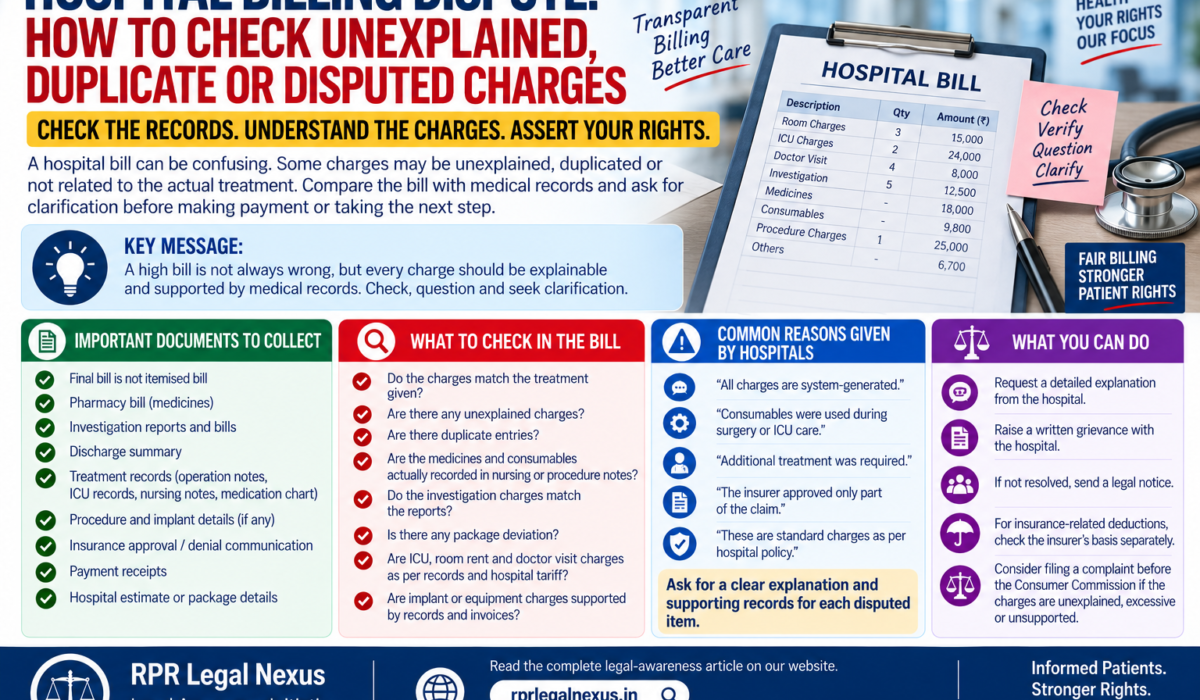
In a hospital billing dispute, the patient or family should first collect the final bill, itemised bill, pharmacy bill, investigation bill, discharge summary, treatment records, payment receipts, insurance approval or denial communication and any hospital estimate. The main question is whether the charges match the treatment actually provided. Unexplained charges, duplicate entries, package deviation, unused medicines, excessive consumables or unsupported ICU/procedure charges should be checked through records. A hospital grievance, written demand, legal notice or Consumer Commission complaint may become relevant depending on the facts and documents.
What Is a Hospital Billing Dispute?
A hospital billing dispute arises when a patient or family questions the correctness, transparency or justification of charges raised by a hospital.
The dispute may involve overcharging, duplicate billing, unexplained consumables, medicines not used, package variation, ICU charges, room-rent issues, doctor-visit charges, procedure charges, implant charges, investigation charges, discharge delay charges or mismatch between the bill and medical records.
Not every high bill is automatically illegal or incorrect. The issue is whether the hospital can explain the bill with records and whether the charges match the treatment, package terms, estimate, insurance approval and hospital tariff where applicable.
Where the billing issue is connected with missing medical documents, readers may also refer to the guide on what to do if a hospital delays or refuses medical records.
Common Reasons Given by Hospitals
Hospitals may say that all charges are system-generated and therefore correct. A system-generated bill can still require explanation if the patient disputes specific entries.
They may say that consumables were used during surgery, ICU care or nursing care. In such cases, the patient should ask whether the consumables are supported by treatment records, procedure notes or nursing records.
Hospitals may say that the bill increased because the patient required additional treatment. The patient should then check whether the medical records show that additional treatment, procedure, investigation or medication.
Hospitals may also say that the insurer approved only part of the claim and therefore the patient must pay the balance. But an insurance deduction does not automatically prove that the hospital bill is correct. Hospital billing issues and insurance claim issues should be checked separately.
If the dispute later becomes an insurance deduction or reimbursement issue, readers may refer to the article on disputing partial insurance claim deductions.
Important Documents to Collect
The patient should first collect the final bill and itemised bill. The final bill gives the total amount, but the itemised bill shows the details of medicines, consumables, investigations, room charges, procedures, professional fees and other items.
The discharge summary should be preserved because it shows the diagnosis, treatment, procedure, hospital course and discharge advice. But the discharge summary alone may not explain every bill item.
The patient should also collect pharmacy bills, investigation reports, procedure notes, operation notes where surgery was done, ICU records where applicable, nursing notes, medication chart and payment receipts.
If insurance was involved, the family should preserve cashless approval, denial communication, deduction sheet, TPA emails, claim number and insurer settlement details.
The NMC-hosted Code of Medical Ethics Regulations, 2002 contains provisions on maintaining indoor-patient records and providing medical records within the stated time when requested by the patient or authorised representative. This can become relevant when treatment records are necessary to verify disputed hospital charges.
How to Check Duplicate Charges
Duplicate charges may appear when the same medicine, investigation, procedure, room charge or consumable is billed more than once.
The patient should not assume duplication only because similar words appear twice. Some medicines or consumables may be used repeatedly during admission. The question is whether the duplicate entry corresponds to actual repeated use.
The itemised bill should be checked date-wise. If the same investigation appears twice on the same day, check whether two tests were actually done. If multiple doctor visits are billed, check whether the records show those visits. If pharmacy items are repeated, check whether they were issued and administered.
A practical method is to mark every doubtful entry and ask the hospital for a written explanation or billing clarification.
How to Check Unexplained Consumables
Consumables are a common area of billing dispute. These may include gloves, syringes, tubes, dressings, catheters, surgical materials, PPE items, procedure kits, disposable equipment and ICU-related items.
In surgery or ICU cases, consumables may be substantial. However, the bill should still be explainable.
The patient may ask whether the consumables were used during a specific procedure, ICU care, dressing, nursing care or treatment process. Where the quantity appears excessive, the patient may request clarification.
If the dispute involves surgery, operation notes and nursing records may help verify whether certain consumables were likely used. The guide on hospital records after a surgery complication explains why operation notes, anaesthesia records and nursing records can become important in surgery-related disputes.
How to Check Medicine and Pharmacy Charges
Pharmacy charges should be compared with prescriptions, medication chart and discharge medicines.
In inpatient treatment, medicines may be issued by the hospital pharmacy and administered according to the medication chart. If a medicine was billed but not administered, the patient may ask for clarification.
Sometimes medicines may be returned to the pharmacy if unused. The patient should check whether returned medicines were properly adjusted in the bill.
If medicines were purchased separately from outside, those bills should be preserved. The patient should also verify whether the hospital bill includes medicines that were already separately purchased.
In prolonged admissions, a date-wise pharmacy bill can help identify whether charges match the treatment record.
How to Check Room Rent, ICU and Nursing Charges
Room rent and ICU charges should be compared with the actual dates and time of admission, shifting and discharge.
If the patient was shifted from ward to ICU or ICU to room, the timing should be checked. Sometimes billing disputes arise because a full day is charged despite shifting or discharge at a particular time. The hospital’s billing policy should also be checked.
ICU charges should correspond to ICU admission records, monitoring charts and treatment notes. If the patient was not in ICU for a billed period, the dispute should be raised with the hospital billing department.
Nursing charges should also be examined where they are separately billed. The patient should ask whether such charges are part of the room package or separately chargeable under the hospital tariff.
How to Check Procedure, Surgery or Package Charges
Hospitals may quote a package amount for a surgery or procedure. Later, the final bill may be higher due to additional stay, complications, extra medicines, implants, ICU care or investigations.
The patient should compare the estimate, package communication and final bill. If the hospital promised a package, the patient should check what was included and excluded.
Procedure charges should be supported by procedure notes or operation notes. If an additional procedure is billed, the patient should check whether it was performed, consented to and recorded.
Implant charges should be supported by invoice, sticker, batch details or manufacturer details where applicable.
If the dispute concerns whether the treatment itself was proper or whether a complication increased the bill, readers may also refer to the article on medical negligence or known complication.
Billing Dispute After Cashless Insurance Denial
Hospital billing disputes often arise after cashless insurance denial. The family may be forced to pay directly before discharge and later discover that the insurer has refused or reduced the claim.
Cashless denial does not automatically mean the hospital bill is wrong. At the same time, the fact that a hospital demanded payment after cashless denial does not prevent the patient from later checking the bill.
The patient should preserve the cashless denial letter, TPA query, final bill, itemised bill, payment receipts and discharge records.
Where the issue concerns whether reimbursement may still be possible after cashless denial, readers may refer to the article on cashless health insurance denial and final claim rejection.
What the Patient or Family Should Do First
The first practical step is to request the itemised bill. Without itemised details, it is difficult to identify which charge is disputed.
The second step is to collect the treatment records. Billing entries should be compared with medical records, not only with memory.
The third step is to prepare a disputed-charge list. The list should mention the bill item, date, amount, reason for dispute and clarification requested.
The fourth step is to send a written complaint or billing clarification request to the hospital. Oral discussion at the billing counter may not be enough.
The fifth step is to preserve payment proof. If payment was made under pressure for discharge, the patient should preserve receipts and communication.
The sixth step is to separate billing issues from medical negligence or insurance issues. These issues may overlap, but they should be analysed separately.
When Hospital Grievance, Legal Notice or Consumer Commission Proceeding May Be Relevant
A hospital grievance may be relevant where the hospital does not provide an itemised bill, refuses to explain specific charges, fails to adjust returned medicines, charges for services not provided or ignores written billing objections.
A legal notice may be considered where the billing dispute involves substantial unexplained charges, duplicate billing, refusal to provide records, non-refund of excess amount or failure to respond to written requests.
A Consumer Commission complaint may be considered where there is alleged deficiency in service, unfair billing, non-supply of records, overcharging, failure to provide itemised explanation or financial loss caused by hospital service.
The National Consumer Helpline’s official material explains “deficiency” as fault, imperfection, shortcoming or inadequacy in the quality, nature and manner of performance required by law or undertaken under a contract or otherwise in relation to any service. This principle may become relevant in suitable hospital-billing disputes depending on the facts and evidence.
For related service information, readers may refer to the page on hospital billing disputes.
Legal Issues
Hospital billing disputes usually involve transparency of charges, correctness of itemised bills, treatment-record support, package terms, consent for procedures, insurance approval, refund of excess amount and deficiency in service.
The patient must show which charge is disputed and why. A general allegation that the bill is high may not be enough.
The hospital should be able to explain the disputed charges with reference to treatment records, tariff, package terms, procedure notes, medicine records, nursing records or ICU records where applicable.
If billing records are connected with suspected negligent treatment, the issue may require separate medical-record review. The article on medical negligence evidence patients should collect may be useful in such cases.
Important Mistakes to Avoid
Patients should not leave the hospital without collecting the final bill, itemised bill and payment receipts.
They should not rely only on oral billing explanations. Written clarification should be requested for disputed charges.
Patients should not submit original bills to the insurer without keeping copies.
They should not assume that insurance deduction proves hospital overbilling. The insurer may deduct amounts for policy reasons even if the hospital bill reflects actual charges.
They should also avoid mixing all grievances into one vague allegation. Duplicate billing, unexplained consumables, medicine charges, insurance denial and medical negligence should be separately identified.
Another important mistake is delay. If a billing dispute exists, the patient should raise it promptly and preserve records.
Practical Relevance for Consumers
Hospital billing disputes may arise after emergency admission, surgery, ICU care, delivery, cancer treatment, cardiac care, accident treatment, diagnostic procedures, day-care procedures or prolonged hospitalisation.
Patients and families considering any further step should first organise the final bill, itemised bill, discharge summary, prescriptions, medication chart, investigation reports, operation notes, ICU records, insurance communication and payment receipts.
The correct legal remedy may differ depending on the place of treatment, hospital response, amount disputed, records available, insurance involvement, jurisdiction, limitation period and relief sought.
For broader consumer-law context, readers may also refer to consumer law services.
Frequently Asked Questions
Is a high hospital bill automatically illegal?
No. A high bill is not automatically illegal. The issue is whether the bill is supported by treatment records, tariff, package terms, medicines, procedures and services actually provided.
What is the first document to ask for in a billing dispute?
The itemised bill is usually the first document to request. It helps identify which specific charges are disputed.
Can a patient ask for medical records to verify the bill?
Yes. Treatment records may be necessary to verify procedure charges, ICU charges, medicines, investigations and consumables.
What if medicines were billed but not used?
The patient should compare the pharmacy bill with the medication chart and ask the hospital for clarification. Returned medicines should be adjusted where applicable.
Can insurance denial and hospital billing dispute be handled together?
They may be connected, but they should be analysed separately. Insurance denial depends on policy terms, while hospital billing depends on services and charges.
Can duplicate billing be challenged?
Yes. The patient should identify the duplicate entries, dates and amounts, and request written clarification or correction from the hospital.
Can a Consumer Commission complaint be filed for hospital billing disputes?
A complaint may be considered where there is alleged deficiency in service, overcharging, non-supply of records, unfair billing or refusal to refund excess charges, depending on the facts and evidence.
Related Consumer Law Services
Readers dealing with unexplained hospital bills, duplicate charges, non-supply of itemised bills, insurance-linked billing disputes, medical-record issues or suspected treatment-related disputes may refer to the pages on hospital billing disputes, medical negligence and hospital disputes, health insurance claim rejection disputes and consumer law services for related information.
Practical Document Checklist Before Taking Any Step
In a hospital billing dispute, the first practical step is to organise the final bill, itemised bill, pharmacy bills, investigation bills, discharge summary, prescriptions, medication chart, operation notes where relevant, ICU records where relevant, payment receipts, insurance approval or denial communication, hospital estimate and written billing objections.
After the records are organised, the issue should be examined carefully to understand whether the grievance relates to duplicate billing, unexplained consumables, unused medicines, excessive room or ICU charges, package deviation, procedure charges, implant charges, insurance deductions, non-supply of records or another consumer law issue.
A clear document-based understanding helps avoid vague allegations and supports a more responsible decision on the next legal or procedural step.
RPR Legal Nexus
Adv. Raghesh Issac P
Consumer Law Advocate
Ernakulam, Kerala
Call / WhatsApp: 9400222945
Email: rprkeralaservices@gmail.com
Office:
60/3877A-3, Luiz Lane, near Thevara Market
Perumanoor, Kochi, Ernakulam, Kerala 682015
Follow RPR Legal Nexus
Google Maps / Google Business Profile
WhatsApp Channel
Facebook
Instagram
LinkedIn Company Page
LinkedIn Profile of Adv. Raghesh Issac P
YouTube Channel
Disclaimer
This article is provided solely for general legal awareness and should not be treated as legal advice. Hospital billing disputes depend on the bill, itemised charges, treatment records, hospital tariff, insurance communication, payment proof, jurisdiction, limitation period and the facts of each matter.No lawyer-client relationship is created merely by reading this article, visiting the website, submitting an enquiry or sharing preliminary information. Legal advice or representation can be provided only after proper review of the facts and documents and professional engagement.RPR Legal Nexus mainly handles suitable consumer law matters.
Written/Reviewed by: Adv. Raghesh Issac P
Consumer Law Advocate
RPR Legal Nexus
Ernakulam, Kerala
Published: 20/09/2026
Last reviewed: 20/09/2026