






Consumer Commission Complaint in Kerala: Documents to Organise Before Filing a Case
A Consumer Commission complaint becomes stronger when the documents are properly organised before filing. Many consumers have genuine grievances, but their records may be scattered across WhatsApp chats, emails, invoices, bills, bank transfers, hospital records, insurance letters, photographs and complaint receipts.
A complaint should not be prepared only from memory. The documents must show who the consumer is, who the opposite party is, what service or product was purchased, what went wrong, what loss was caused, what steps were already taken and what relief is being claimed.
This article explains the important documents consumers should organise before filing a Consumer Commission complaint in Kerala.
In Brief
Before filing a Consumer Commission complaint, the consumer should organise proof of purchase or service, payment records, agreement or invoice, complaint communications, legal notice if any, opposite party reply, photographs, expert reports, bills, loss proof and identity/address details. The documents should be arranged chronologically and connected to the specific relief claimed. The correct forum, jurisdiction, limitation period, party details, claim value and evidence must be checked before filing. A well-organised file helps avoid vague allegations and supports a clearer consumer complaint.
What Is the Issue?
Consumer disputes may arise from defective products, deficient services, insurance claim rejection, hospital billing disputes, medical negligence, construction delay, contractor abandonment, banking errors, CIBIL reporting mistakes, warranty denial, travel refund delay, visa-service failure or e-commerce complaints.
The Consumer Protection Act, 2019 provides a legal framework for consumer complaints relating to goods and services. Official Consumer Affairs material describes Consumer Commissions as a three-tier quasi-judicial machinery at District, State and Central levels for consumer disputes and unfair trade practices.
The issue for most consumers is not only whether they have a grievance. The practical issue is whether they have organised the documents needed to prove the grievance.
Why Document Organisation Matters
A Consumer Commission complaint must tell a clear story supported by records. The complaint should not be a long emotional narration without documents.
A document-based complaint helps show the transaction, payment, deficiency, loss and relief. It also helps anticipate the opposite party’s defence.
For example, in an insurance dispute, the policy, rejection letter and medical records may be central. In a construction dispute, the agreement, payment proof, site photographs and engineer report may be crucial. In a CIBIL dispute, the credit report, no-dues certificate and bank communication may be important.
The same principle applies across consumer cases: the documents must match the allegations.
Common Mistakes Before Filing a Consumer Complaint
One common mistake is filing a complaint without arranging documents in date order. This makes the facts difficult to understand.
Another mistake is not preserving proof of payment. Bank transfers, UPI receipts, cheque details, invoices and receipts are often essential.
Some consumers preserve screenshots but not full conversations. In WhatsApp-based disputes, isolated screenshots may not show the full context.
Consumers also sometimes claim high compensation without showing how the amount is connected to actual loss, expenses, delay, mental agony or deficiency.
Another frequent mistake is filing against the wrong party or omitting a necessary party. The correct legal name, branch address, registered office, service centre, hospital, insurer, contractor or platform should be verified as far as possible.
Basic Documents Needed in Most Consumer Cases
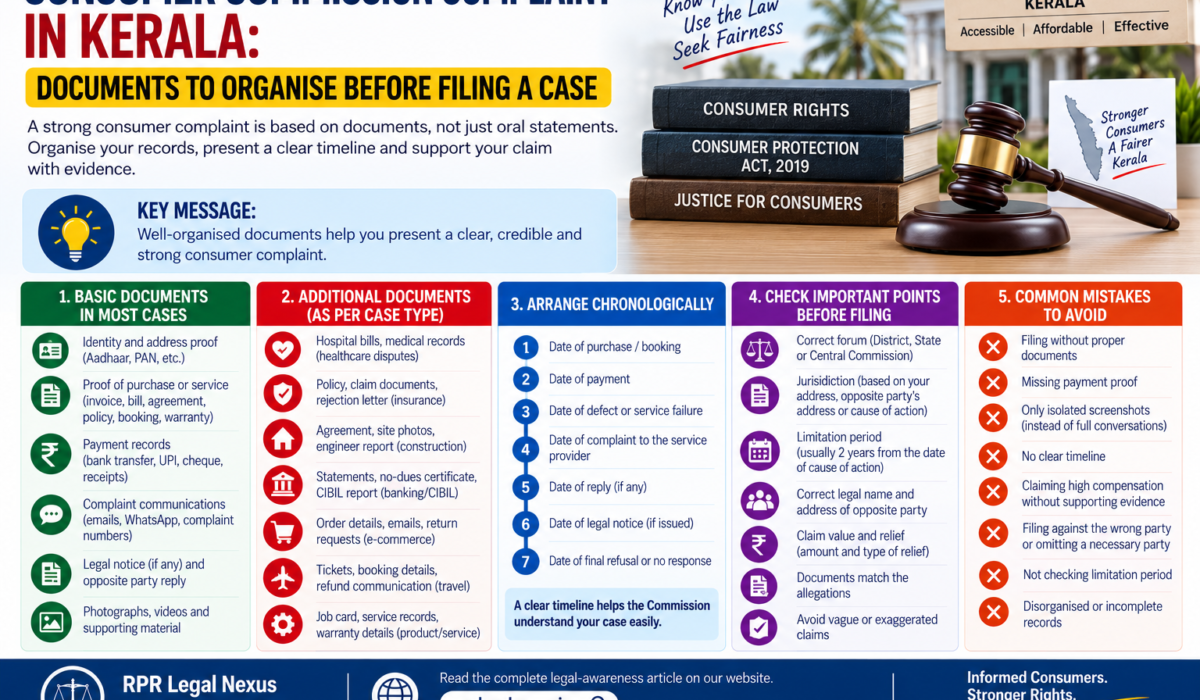
The consumer should preserve identity and address documents, because party details and jurisdiction may become relevant.
The transaction records are also important. These may include invoice, bill, receipt, agreement, quotation, policy schedule, booking confirmation, warranty card, job card, estimate, payment proof or service contract.
The complaint history should be preserved. This may include emails, WhatsApp messages, complaint ticket numbers, grievance acknowledgments, customer-care replies, legal notice, postal receipt and opposite party reply.
Loss documents should also be collected. These may include repair bills, medical bills, travel expenses, alternate purchase bills, bank statements, loan rejection proof, expert reports, photographs, videos or other supporting material.
If the dispute concerns a service provider’s failure, the consumer should preserve proof of what was promised and how the service failed.
Arrange the Documents Chronologically
A simple chronological arrangement can make the complaint much clearer.
The consumer should prepare a timeline showing the date of purchase, date of payment, date of defect or service failure, date of complaint, date of reply, date of legal notice and date of final refusal.
Each document should be placed according to this timeline.
For example, in a contractor dispute, the timeline may start with quotation, then advance payment, commencement of work, further payments, delay, stoppage, photographs, demand messages and engineer report.
In a health insurance dispute, the timeline may show policy start date, hospitalisation, claim submission, insurer query, document submission, rejection letter and grievance.
This method helps the complaint read like a coherent case rather than a bundle of disconnected documents.
Documents for Insurance Claim Disputes
In insurance disputes, the consumer should preserve the policy schedule, complete policy wording, premium receipts, claim form, rejection letter, settlement letter, deduction sheet, surveyor report, bills, photographs, medical records or repair records, insurer emails and grievance communications.
If the issue is health insurance claim rejection, the article on what to check before accepting a health insurance claim rejection may be useful.
If the insurer alleges non-disclosure, the proposal form and earlier medical records become very important. Readers may refer to the guide on health insurance non-disclosure disputes.
If the insurer paid only part of the claim, the article on partial insurance settlement and claim deductions may help identify relevant documents.
Documents for Medical Negligence and Hospital Disputes
In medical negligence matters, the patient should organise the full medical file. The discharge summary alone may not be enough.
Important documents may include admission records, case sheet, consent forms, investigation reports, operation notes, anaesthesia records, nursing notes, ICU records, medication chart, bills, payment receipts, hospital communications and later treatment records.
Where surgery is involved, the article on important hospital records after a surgery complication may be useful.
If the issue is billing, the article on hospital billing dispute and disputed charges may help organise bills, itemised charges and supporting records.
If the hospital delays or refuses records, the guide on hospital medical-record delay and patient steps may also be relevant.
Documents for Construction and Contractor Disputes
In construction disputes, the consumer should preserve the agreement, quotation, estimate, drawings, specifications, payment records, receipts, bank transfers, site photographs, videos, WhatsApp messages and engineer report if available.
If the contractor took advance but did not complete the work, the article on contractor advance-payment evidence may be useful.
If the issue involves cracks, leakage or poor workmanship, the guide on defective house construction evidence explains what photographs, reports and repair records may be important.
Construction disputes often require technical clarity. The consumer should separate incomplete work, delay, defective work, excess payment and rectification cost.
Documents for Banking and CIBIL Disputes
Banking disputes may involve unauthorised transactions, wrong charges, loan closure errors, credit-card disputes, CIBIL reporting mistakes or failure to correct records.
The consumer should preserve account statements, transaction alerts, complaint emails, ticket numbers, bank replies, payment proof, credit-card statements, loan closure letters, no-dues certificates and credit reports.
Where the issue is wrong CIBIL reporting after loan closure, the article on wrong CIBIL entry after loan closure may help identify relevant records.
The consumer should preserve the latest full credit report rather than only a credit-score screenshot.
Documents for Warranty, Service Centre and Product Disputes
In product and warranty disputes, the consumer should preserve the purchase invoice, warranty card, job card, service request number, inspection report, service centre communication, photographs, videos, repair estimate and manufacturer reply.
If a product was given for repair, the job card is important because it may show the date of handover, complaint reported, condition of the product and expected delivery date.
Where poor service, delay or warranty rejection is alleged, the consumer should preserve all service-centre messages and call records where legally usable.
Documents for Travel, Visa, Refund and Service Failure Disputes
In travel and refund disputes, the consumer should preserve booking confirmation, payment proof, cancellation request, refund policy, airline or travel-agency communication, visa-service agreement, receipts and refusal or delay communication.
If the dispute involves a study-abroad, job-abroad or visa service provider, the consumer should preserve brochure, advertisement, offer letter, agreement, payment receipts, WhatsApp messages, email promises and refund assurance.
The central question is what service was promised, what payment was made and how the service failed.
Proof of Communication With the Opposite Party
Communication records are often decisive in consumer disputes.
The consumer should preserve emails, WhatsApp messages, SMS, complaint-ticket numbers, call summaries, postal notices, courier receipts and replies.
For WhatsApp messages, it is better to preserve the full conversation rather than isolated screenshots. Screenshots should show the phone number or name, date and content.
If a legal notice was sent, preserve the notice copy, postal receipt, tracking report and reply.
If the opposite party admitted fault, promised refund, assured repair or acknowledged delay, those messages should be preserved carefully.
Proof of Loss and Relief Claimed
The relief claimed in the complaint should be supported by documents.
If refund is claimed, payment proof and non-delivery or non-performance evidence should be attached.
If repair cost is claimed, repair estimate or invoice should be preserved.
If reimbursement is claimed, bills and receipts are important.
If compensation is claimed, the complaint should explain the inconvenience, delay, financial loss, mental agony, repeated follow-up and deficiency in service.
Compensation should not be a random number. It should be linked to facts and supported by the seriousness of the deficiency.
Jurisdiction, Limitation and Forum Selection
Before filing, the consumer should check whether the complaint is being filed before the proper Consumer Commission.
The Consumer Protection Act, 2019 contains provisions on territorial jurisdiction, including filing where the opposite party carries on business or where the complainant resides or personally works for gain, subject to the Act. The latest statutory provisions and pecuniary jurisdiction should be checked before filing.
Official Consumer Affairs material also highlights online filing and jurisdiction linked to the consumer’s place of residence or work.
Limitation must also be checked. Under the Consumer Protection Act, complaints are generally subject to a limitation framework, and delay may require a proper explanation and condonation request where applicable. The consumer should not wait unnecessarily after final refusal or cause of action.
Online Filing and E-Daakhil/E-Jagriti
Consumer complaints may be filed physically or through online filing systems where available.
PIB material explains that the e-Daakhil portal was set up to allow consumers to file complaints online, with online fee payment and digital submission facilities. It also notes features such as e-notice, document download links, video-conferencing hearing links and SMS/email alerts.
While online filing may be convenient, the complaint file still needs proper documents. Scanned copies should be clear, complete and readable. File names should be organised logically.
What the Consumer Should Do First
The first step is to create a master folder for the case.
The second step is to arrange documents in date order.
The third step is to prepare a short timeline.
The fourth step is to identify the parties correctly.
The fifth step is to list the reliefs sought.
The sixth step is to check whether any expert report, technical opinion, medical record, surveyor report or credit report is required.
The seventh step is to prepare a document index before drafting or filing.
This preparation helps avoid weak pleadings, missing annexures and unclear reliefs.
Legal Issues
Consumer complaints usually involve deficiency in service, unfair trade practice, defective goods, non-refund, delay, wrongful rejection, overcharging, negligent service, failure to honour warranty or other consumer-service issues.
However, each complaint must be built on specific facts. The complaint should identify the transaction, defect or deficiency, supporting documents, loss and relief.
The consumer must also ensure that the dispute is suitable for consumer jurisdiction. Some disputes may involve complex title, partnership, employment, pure civil disputes or other issues outside ordinary consumer service deficiency. Proper legal assessment may be needed before filing.
Important Mistakes to Avoid
Consumers should not file a complaint without proof of payment or transaction.
They should not rely only on oral promises.
They should not attach unclear screenshots without date, sender and context.
They should not claim exaggerated compensation without explaining the basis.
They should not omit necessary opposite parties.
They should not ignore limitation.
They should not mix unrelated grievances in one complaint unless they are connected to the same transaction or service.
They should also avoid filing before the wrong forum without checking jurisdiction and claim value.
Practical Relevance for Consumers
Proper document organisation is useful in almost every consumer dispute, including insurance, hospital billing, medical negligence, construction, banking, CIBIL, warranty, service centre, travel, refund and e-commerce cases.
A well-organised complaint file helps the consumer understand the strengths and weaknesses of the case before filing.
The correct legal remedy may differ depending on the type of service, place of transaction, residence of parties, value of claim, limitation period, evidence and relief sought.
For broader consumer-law service information, readers may refer to consumer law services.
Frequently Asked Questions
Is a legal notice compulsory before filing a Consumer Commission complaint?
A legal notice may not be compulsory in every consumer case, but it is often useful. It records the grievance, gives the opposite party an opportunity to respond and may help clarify the dispute before filing.
What is the most important document in a consumer case?
It depends on the dispute. In most cases, proof of transaction or service, payment proof, complaint communication and evidence of deficiency are very important.
Can WhatsApp messages be used in consumer cases?
WhatsApp messages may be relevant if they show the transaction, promise, admission, complaint or refusal. The conversation should be preserved properly with dates, numbers and context.
Should documents be arranged date-wise?
Yes. Chronological arrangement helps present the case clearly and avoids confusion.
Can a consumer file online?
Online filing facilities exist through consumer complaint e-filing systems. Documents should be scanned clearly and uploaded in an organised manner.
What if some documents are missing?
The consumer should try to obtain missing documents through written requests. If still unavailable, the complaint should explain what is missing and why, supported by available evidence.
Can compensation be claimed for mental agony?
Compensation may be claimed where facts support it, but the amount should be reasonable and connected to the deficiency, inconvenience, financial loss and circumstances of the case.
Related Consumer Law Services
Readers preparing documents for a Consumer Commission complaint may refer to the pages on consumer law services, insurance claim disputes, medical negligence and hospital disputes, construction disputes, banking and credit-card disputes and CIBIL and credit-report disputes for related information.
Practical Document Checklist Before Taking Any Step
Before filing a Consumer Commission complaint, the consumer should organise identity proof, address proof, invoice, bill, receipt, agreement, quotation, policy, warranty card, payment proof, photographs, videos, complaint emails, WhatsApp messages, legal notice, postal proof, opposite party reply, expert report, medical records, insurance records, bank statements, credit report, repair bills, loss proof and relief calculation.
After organising the documents, the consumer should prepare a timeline, identify the correct opposite parties, check jurisdiction and limitation, prepare a document index and ensure that every major allegation is supported by at least one record wherever possible.
A complaint-ready file helps convert a grievance into a structured consumer case.
RPR Legal Nexus
Adv. Raghesh Issac P
Consumer Law Advocate
Ernakulam, Kerala
Call / WhatsApp: 9400222945
Email: rprkeralaservices@gmail.com
Office:
60/3877A-3, Luiz Lane, near Thevara Market
Perumanoor, Kochi, Ernakulam, Kerala 682015
Follow RPR Legal Nexus
Google Maps / Google Business Profile
WhatsApp Channel
Facebook
Instagram
LinkedIn Company Page
LinkedIn Profile of Adv. Raghesh Issac P
YouTube Channel
Disclaimer
This article is provided solely for general legal awareness and should not be treated as legal advice. Consumer Commission complaints depend on the transaction, documents, jurisdiction, limitation period, evidence, parties, relief sought and facts of each matter.No lawyer-client relationship is created merely by reading this article, visiting the website, submitting an enquiry or sharing preliminary information. Legal advice or representation can be provided only after proper review of the facts and documents and professional engagement.RPR Legal Nexus mainly handles suitable consumer law matters. MACT cases, road accident injury compensation claims, criminal cases, family cases and property partition disputes are not the main service areas of this practice.
Written/Reviewed by: Adv. Raghesh Issac P
Consumer Law Advocate
RPR Legal Nexus
Ernakulam, Kerala
Published: 22/09/2026
Last reviewed: 22/09/2026